St Thomas’ History
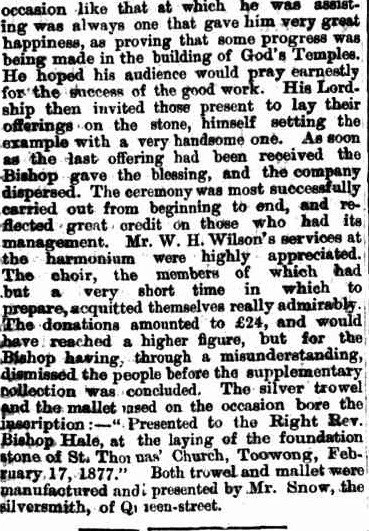
St Thomas' Church of England was constructed in 1877 replacing an 1865 timber building on another site at Curlew Street which was itself a part of the parish of All Saints’ Church in Wickham Terrace. In 1870, St Thomas’ became a parish, independent of All Saints’. The church was designed by parishioner and prominent Brisbane architect, F.D.G. Stanley, and has had two major additions. The first addition was in 1886 when the nave was extended, and the second addition was in 1947 when transepts and a chancel were added. The foundation stone was laid by Bishop Hale on 17 February 1877. The contractor was Henry Pierce and the building cost 850 pounds. An official opening ceremony in the form of a service was held on 13 October 1877.
The southern, entrance end of the church addresses the corner of the two streets, where three substantial gate pillars with an iron palisade gate provide a principal entrance to the grounds of the church. Two sets of concrete stairs containing memorial gate posts and memorial plaques give access from the church grounds to the streets flanking the site.
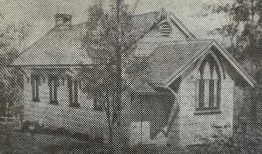
St Thomas’ Church at Curlew Street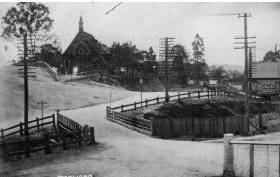
St Thomas’ Church, Toowong c. 1917Heritage listing
St Thomas' Anglican Church was listed on the Queensland Heritage Register on 21 October 1992 having satisfied the requisite criteria.
St Thomas' Church is important in demonstrating the pattern of growth of Toowong from an elite residential settlement in the 1860s to closer settlement following the introduction of the railway in the mid-1870s. As home to one of the earliest established Church of England parishes in Queensland, St Thomas' Church illustrates the development of the Church in the state.
The building is a fine example of nineteenth century church architecture, showing a strong influence of an Early English Gothic style, which informed most ecclesiastical buildings of the second half of the nineteenth century. Elements of St Thomas' which show this Gothic influence include the steeply pitched and dominant roofscape; the picturesque setting of the building; bi-chrome brickwork; lancet and pointed arched openings; gabled porches; cruciform plan; heavy internal roof trusses and stained and coloured glass.
St Thomas' Church has remarkable aesthetic value with strong landmark qualities; it is a well composed building picturesquely situated on a prominent site. The building has many well-crafted items of considerable aesthetic value including internal joinery, particularly the altar, pulpit, lectern and internal panelling; stained and coloured glass windows of William Bustard; font; various internal and external memorials and landscaping. The established plantings surrounding the church contribute to its picturesqueness and contain remnants of nineteenth and twentieth century garden design.
The church has a special association with the St Thomas' parish as their principal place of worship for about 120 years.
The building has associations with prominent Brisbane architect, FDG Stanley and with other early parishioners, many of whom were important in the early history of the Church of England in Queensland. Being included on the Queensland Heritage Register give St Thomas’ Toowong the opportunity to apply for Queensland Heritage grants.
Books written about the Church of St Thomas the Apostle, Toowong are available in the State Library of Queensland and include:
St Thomas’ Church Toowong Diamond Jubilee 1870-1930.
Gregory, Helen; Henricksen, Noel (2007), A church for its times : the story of the church of St Thomas the Apostle, Toowong, Anglican Parish of Toowong, ISBN 978-0-646-47589-9 is available to purchase in the St Thomas Bookshop.
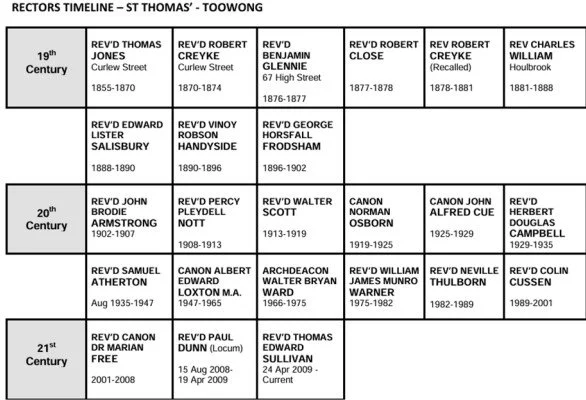
Past Rectors
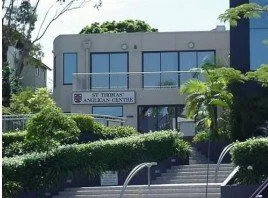
St Thomas’ Parish Centre, and its predecessors
In the early 1960s, a new low set brick rectory was constructed adjacent to the church, and this and the nineteenth century Sunday School and Parish Hall survived to the north of the church, although a fire in May 1970 gutted the school. By the 1980s, the upkeep on the rectory, Sunday school and hall (used for both church and community functions) was becoming too expensive, but equally the church could not afford to replace these buildings. In 1987, a commercial developer proposed to buy the land occupied by the rectory, Sunday school and hall and construct a large commercial building with the church having use of part of the building for its purposes with an off-site rectory (High Street having become too noisy and commercial). This was a controversial proposal within the congregation, but it was agreed to proceed, but the overall development was cancelled due to the downturn in the property market. However, the concept remained alive within the congregation and a similar commercial development arrangement was completed in 1998 with a parish centre established as part of a larger commercial building.
St Thomas’ has a modern Parish Centre with facilities where we meet after our services for morning tea. The lower half of the Parish Centre is used by the parish for the Rector and bookshop. The upper half of the Parish Centre is offered for rent at January 2025.
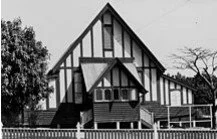
: St Thomas Parish Hall c. 1940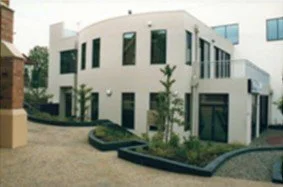
Car parking for the Church and Parish Centre is located under 67 High St building. For those attending Sunday morning service at St Thomas' Church, car parking is available from 7.00am until 10.30am every Sunday ONLY.St Thomas’ Pipe Organ & Piano
The original organ was built by B B Whitehouse in 1886, and enlarged in 1948 by Whitehouse Bros. Brisbane. The current pipe organ was rebuilt and enlarged in 1962 by H W Jarrott Brisbane and has 2 manuals, pedal Board, 11 speaking ranks of pipes and electric action. Major cleaning and slide tuning was carried out by Doug Milne (tuning and maintenance) and Graham Hyde (Assistant Organist) in January 2019. The organ is well maintained and tuned by Doug Milne (tuning and maintenance) assisted by Graham Hyde. In 2011 St Thomas' Church benefited from a generous donation from Brad White and Tiffany Xavier of their well loved Broadwood & Sons piano. The piano now sits alongside the organ and is enjoyed by many during services and concerts.
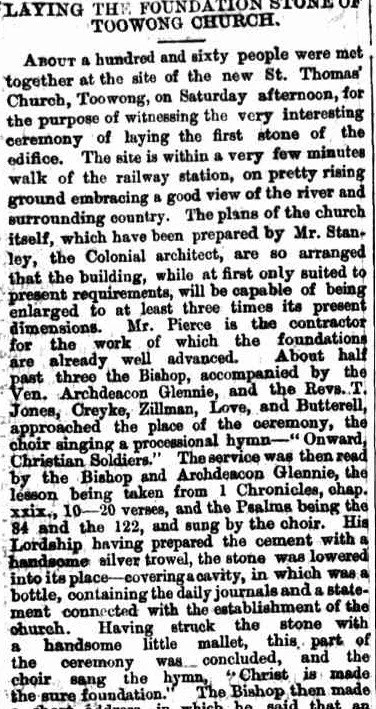
Article from the Brisbane Courier 18 February 1877
Source: https://trove.nla.gov.au/newspaper/article/169511502#